
How to Turn One Customer Call Into a Week of Content (2026)
TL;DR: The blank page is not a writing problem. It's a sourcing problem. The richest source of founder content you have is not your brain at 11pm — it's the customer calls already on your calendar. This is the One Call, One Week method: record the call, mine six specific things from the transcript (the objection, the aha, the number, the phrase, the question, the before-and-after), and turn each into a post. Founders who do this stop asking "what should I post?" because the answer is sitting in a transcript. Below: exactly what to extract, a worked example turning a single 30-minute call into seven posts, and the mistakes that make this feel gross instead of generous.
"What should I post about?" is the wrong question.
It's the question that keeps founders staring at an empty compose box, and it's the reason most founder content dies at what we call the three-week wall — you run out of things to say before you run out of intention to say them.the three-week wall
But you didn't run out of things to say. You said something genuinely sharp this week. You said it out loud, with conviction, to a prospect who was on the fence — and then it evaporated into the ether of a Zoom recording nobody will ever watch again.
The content was already made. You just didn't capture it.
The blank page is a sourcing problem, not a writing problem
Most advice on founder content treats the bottleneck as output: better hooks, better formatting, better prompts. But the founders who post consistently are not better writers. They have a better supply chain. They never start from zero because they've built a habit of harvesting raw material from work they were already doing.
This is also why generic AI drafting plateaus. A model can format an idea, but it cannot manufacture your specific idea — the exact objection your buyer raised on Tuesday, phrased in the exact words they used. Feed a tool nothing and you get slop. Feed it a real transcript and it gets sharp.generic AI drafting plateaus
The customer call is the single densest source of that raw material you own. Nobody else has it. It cannot be scraped, prompted, or copied. It's proprietary by definition.
Why the customer call is the richest vein
A single sales or customer call contains more usable content than a week of brainstorming, for three reasons.
- Real objections. The thing your prospect pushed back on is the thing 500 other buyers are silently thinking. Address it publicly and you're writing to the whole market, not one deal.
- Real language. Your customer described their problem in their words — not your marketing words. That phrasing is gold. April Dunford has built an entire positioning practice on the idea that you should describe value the way customers describe it, not the way you wish they would.
- Real proof. The specific number, the specific before-and-after, the specific moment something clicked — these are the concrete details that make a post credible instead of generic. Specificity is the whole game.
Specificity is what separates a post that sounds like a human from a post that sounds like it was generated. Calls are where specificity lives.Specificity is the whole game
The One Call, One Week method
Here's the system. It has three steps — capture, mine, ship — and the middle one is where the leverage is.
Step 1: Capture
Record the call (with consent — a one-line "I record these for my own notes, all good?" covers it) and get a transcript. Tools like Granola, Fathom, or Otter do this automatically. You are not going to re-watch a 30-minute video. You are going to skim a transcript in four minutes. The transcript is the asset, not the recording.
Step 2: Mine — pull these six things
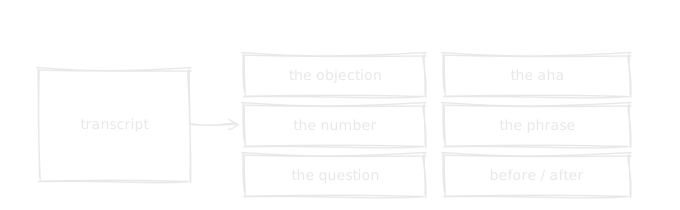
Read the transcript once with a highlighter mindset. You're hunting for six specific patterns. This is the screenshot-able part of this post, so here it is as a checklist:
- The objection — what did they push back on, hesitate on, or need convincing about? ("We already have someone doing this in-house.")
- The aha — the moment something reframed for them, where they said "oh, I hadn't thought about it that way."
- The number — any metric, cost, timeline, or quantity that came up. ("We were spending 6 hours a week on this.")
- The phrase — the exact words they used to describe their problem or their goal. Copy it verbatim into your notes.
- The question — what did they ask you? Their questions are search queries in disguise; other buyers are Googling the same thing.
- The before-and-after — the contrast between where they were and where they want to be. That gap is a story.
One call rarely gives you all six. It usually gives you three or four strong ones. That's still three or four posts from thirty minutes of work you were already doing.
Step 3: Ship
Each mined item becomes its own post with its own angle. You are not writing a case study about the customer. You are extracting the general truth the specific conversation revealed, and writing that to the market. The customer is the spark; your point of view is the post.
One 30-minute call, seven posts (worked example)
Say you're the founder of a B2B analytics tool and you just got off a call with a prospect. Here's how the six patterns become a week of content.
- From the objection ("we have someone in-house for this") → a post on why in-house and specialist aren't either/or, and where each actually wins.
- From the aha ("I didn't realize the setup was the hard part") → a contrarian post: the thing everyone thinks is hard is easy, and the thing they ignore is what kills them.
- From the number ("6 hours a week") → a post quantifying the hidden cost of the status quo, with the math laid out.
- From the phrase ("we're flying blind between board meetings") → a post built entirely around that line, because it's how your whole market feels and nobody's said it out loud.
- From the question ("how do you handle X?") → a straight how-to answering exactly that, which will rank for exactly that.
- From the before-and-after → a narrative post: here's what the before looks like, here's the after, here's the bridge.
- From the call as a whole → a meta post on a pattern you keep hearing across calls this quarter.
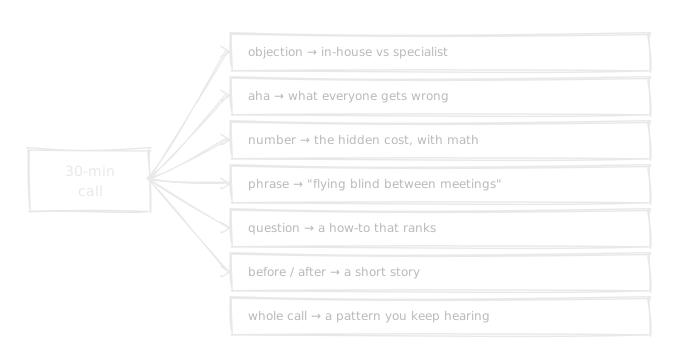
Seven angles, one source. And because each one traces back to a real conversation, none of them read like they were manufactured to fill a calendar. That's the difference between a content operator and a content generator — the operator sources, the generator invents.a content operator and a content generator
This is the same logic behind running one strong idea across channels like LinkedIn and X — you're extracting maximum surface area from one unit of real thinking, not producing more units.running one strong idea across channels like LinkedIn and X
Where the hooks come from
The reason this method produces good posts and not just frequent ones is that the hook is pre-loaded. The customer already handed you the first line. "We're flying blind between board meetings" is a hook you could never have invented at your desk — it only exists because someone said it to you. The best opening lines are earned in conversation, not brainstormed in isolation.The best opening lines are earned in conversation
Adam Robinson built RB2B's audience largely by narrating what he was actually seeing and hearing in the business, in plain language, in real time. Dave Gerhardt has said for years that the best B2B content is just writing down what you already tell customers one-on-one. Chris Walker's whole "dark social" thesis is that the real buying conversations happen in DMs, calls, and communities — so that's where the content should be sourced from too. None of them are inventing takes. They're transcribing a job they were already doing.
Make it a system, not a one-off
Doing this once is a trick. Doing it every week is a moat. The founders who compound an audience are the ones who wired the mining into their calendar so it happens whether or not they feel inspired that day.
The lightweight version is a 30-minute weekly ritual. Block it. Here's what happens inside it:
- Pull the week's transcripts. Every sales call, onboarding, and customer check-in from the last seven days — the tool already recorded them.
- Skim for the six patterns. Highlight objections, ahas, numbers, phrases, questions, and before-and-afters. Four minutes per transcript, tops.
- Dump the highlights into a running doc. This is your backlog. It should always have more raw material than you can post.
- Draft three to five posts from the strongest items — yourself, or with a model fed the actual excerpts.
- Queue them. You now have the week's content sourced from work you already did, before you've written a single word from scratch.
The magic isn't any single post. It's that you've converted a recurring anxiety ("what do I post?") into a recurring input stream. The blank compose box stops being a wall and becomes a formality, because the answer is always waiting in last week's transcripts. This is the difference between doing content and running content as a function — a repeatable process that produces output on a schedule instead of on a mood.running content as a function
What not to do
This method goes wrong in predictable ways. Avoid these:
- Don't name the customer or quote them identifiably without permission. Extract the general truth, not the private detail. "A founder told me last week" is fine; company names and revealing specifics are not.
- Don't turn it into a humblebrag case study. "Another happy customer 🎉" is not content, it's a press release nobody asked for. The post should be useful to someone who will never buy from you.
- Don't manufacture the insight. If the call was flat and gave you nothing, skip it. Forcing a post from a call with no real moment is how you end up writing the generic slop this method is supposed to replace.
- Don't hoard it for months. The half-life of a fresh insight is short. Mine the call within a few days while the specificity is still sharp in your memory.
- Don't outsource the mining to someone who wasn't in the room. The judgment about what mattered on that call is yours. Someone can draft from your notes, but the extraction is the founder's job.
Frequently asked questions
How do I turn a customer call into a LinkedIn post?
Record the call with consent, get a transcript, and skim it for six things: the objection, the aha moment, any number, the customer's exact phrasing, the questions they asked, and the before-and-after of their situation. Each of those becomes a post that extracts the general lesson from the specific conversation. You're writing the market-wide truth the one call revealed, not a case study about the customer.
Is it legal or ethical to make content from customer calls?
Yes, if you do it right. Get consent to record (a quick verbal "I record these for notes" is standard), and never publish identifying details or verbatim quotes without explicit permission. Extract the general pattern, not the private specifics. "A prospect told me their team was flying blind between board meetings" is generous and anonymous; naming the company is not.
What tools should I use to capture and transcribe calls?
Granola, Fathom, Otter, and Fireflies all auto-record and transcribe meetings. The specific tool matters less than the habit: you want a searchable transcript you'll actually skim, not a video you'll never rewatch. The transcript is the raw material; a plain doc of highlighted lines is enough to draft from.
How many posts can I really get from one call?
Realistically three to seven, depending on how rich the conversation was. A dense sales call with real objections and a clear before-and-after can yield a week. A quick check-in might give you one. The point isn't to squeeze a fixed number out of every call — it's to never start from a blank page again because you always have a backlog of sourced material.
Won't every post sound the same if they come from one call?
No — because you're mining six different patterns, each produces a different post shape: an objection becomes an argument, a number becomes an analysis, a phrase becomes a story, a question becomes a how-to. Same source, different angles. The through-line is your point of view, which is a feature, not a bug — consistency of voice is what builds an audience.
Can I use AI to draft these posts?
Yes, and this is exactly where AI drafting actually works. The reason AI content usually reads flat is that it has no proprietary input. When you hand a model a real transcript excerpt and your extracted insight, it has something specific to work with and the output gets dramatically better. The bottleneck was never the drafting — it was the sourcing, and the call solves that.
The shorter version
You don't have a writing problem. You have a capture problem. The best founder content isn't invented at a desk — it's transcribed from conversations you're already having. Record your customer calls, mine each transcript for the objection, the aha, the number, the phrase, the question, and the before-and-after, and turn each into a post that shares the general truth without exposing the private detail. One call, one week. Do this for a month and you'll never stare at a blank compose box again.
This is, functionally, what a good content operation does behind every consistent founder: it sits close to the real conversations, mines them, and ships — so the founder never has to context-switch into "content mode" at all. That's the model we run at Invisible Keyboard: we make the content, from your real inputs, so you can keep taking the calls.the model we run at Invisible Keyboard
Further reading
What to actually post once you've sourced it: the seven content pillars for B2B founders.the seven content pillars for B2B founders